bezier.hazmat.triangle_intersection module
Pure Python helper methods for bezier.triangle.
- bezier.hazmat.triangle_intersection.newton_refine_solve(jac_both, x_val, triangle_x, y_val, triangle_y)
Helper for
newton_refine().We have a system:
[A C][ds] = [E]
[B D][dt]   [F]
This is not a typo,
A->B->C->Dmatches the Fortran-ordering of the data injac_both. We solve directly rather than using a linear algebra utility:ds = (D E - C F) / (A D - B C) dt = (A F - B E) / (A D - B C)
- Parameters:
jac_both (numpy.ndarray) – A
4 x 1matrix of entries in a Jacobian.x_val (float) – An
x-value we are trying to reach.triangle_x (float) – The actual
x-value we are currently at.y_val (float) – An
y-value we are trying to reach.triangle_y (float) – The actual
y-value we are currently at.
- Returns:
The pair of values the solve the linear system.
- Return type:
- bezier.hazmat.triangle_intersection.newton_refine(nodes, degree, x_val, y_val, s, t)
Refine a solution to \(B(s, t) = p\) using Newton’s method.
Note
There is also a Fortran implementation of this function, which will be used if it can be built.
Computes updates via
\[\begin{split}\left[\begin{array}{c} 0 \\ 0 \end{array}\right] \approx \left(B\left(s_{\ast}, t_{\ast}\right) - \left[\begin{array}{c} x \\ y \end{array}\right]\right) + \left[\begin{array}{c c} B_s\left(s_{\ast}, t_{\ast}\right) & B_t\left(s_{\ast}, t_{\ast}\right) \end{array}\right] \left[\begin{array}{c} \Delta s \\ \Delta t \end{array}\right]\end{split}\]For example, (with weights \(\lambda_1 = 1 - s - t, \lambda_2 = s, \lambda_3 = t\)) consider the triangle
\[\begin{split}B(s, t) = \left[\begin{array}{c} 0 \\ 0 \end{array}\right] \lambda_1^2 + \left[\begin{array}{c} 1 \\ 0 \end{array}\right] 2 \lambda_1 \lambda_2 + \left[\begin{array}{c} 2 \\ 0 \end{array}\right] \lambda_2^2 + \left[\begin{array}{c} 2 \\ 1 \end{array}\right] 2 \lambda_1 \lambda_3 + \left[\begin{array}{c} 2 \\ 2 \end{array}\right] 2 \lambda_2 \lambda_1 + \left[\begin{array}{c} 0 \\ 2 \end{array}\right] \lambda_3^2\end{split}\]and the point \(B\left(\frac{1}{4}, \frac{1}{2}\right) = \frac{1}{4} \left[\begin{array}{c} 5 \\ 5 \end{array}\right]\).
Starting from the wrong point \(s = \frac{1}{2}, t = \frac{1}{4}\), we have
\[\begin{split}\begin{align*} \left[\begin{array}{c} x \\ y \end{array}\right] - B\left(\frac{1}{2}, \frac{1}{4}\right) &= \frac{1}{4} \left[\begin{array}{c} -1 \\ 2 \end{array}\right] \\ DB\left(\frac{1}{2}, \frac{1}{4}\right) &= \frac{1}{2} \left[\begin{array}{c c} 3 & 2 \\ 1 & 6 \end{array}\right] \\ \Longrightarrow \left[\begin{array}{c} \Delta s \\ \Delta t \end{array}\right] &= \frac{1}{32} \left[\begin{array}{c} -10 \\ 7 \end{array}\right] \end{align*}\end{split}\]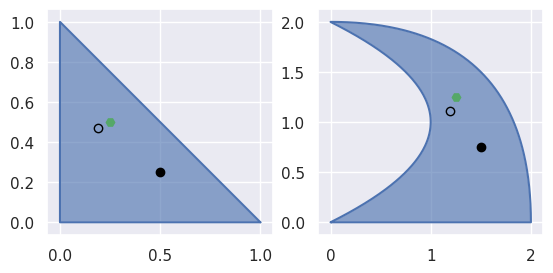
>>> import bezier
>>> import numpy as np
>>> nodes = np.asfortranarray([
...     [0.0, 1.0, 2.0, 2.0, 2.0, 0.0],
...     [0.0, 0.0, 0.0, 1.0, 2.0, 2.0],
... ])
>>> triangle = bezier.Triangle(nodes, degree=2)
>>> bool(triangle.is_valid)
True
>>> (x_val,), (y_val,) = triangle.evaluate_cartesian(0.25, 0.5)
>>> float(x_val), float(y_val)
(1.25, 1.25)
>>> s, t = 0.5, 0.25
>>> new_s, new_t = newton_refine(nodes, 2, x_val, y_val, s, t)
>>> float(32 * (new_s - s))
-10.0
>>> float(32 * (new_t - t))
7.0
- Parameters:
nodes (numpy.ndarray) – Array of nodes in a triangle.
degree (int) – The degree of the triangle.
x_val (float) – The \(x\)-coordinate of a point on the triangle.
y_val (float) – The \(y\)-coordinate of a point on the triangle.
s (float) – Approximate \(s\)-value to be refined.
t (float) – Approximate \(t\)-value to be refined.
- Returns:
The refined \(s\) and \(t\) values.
- Return type:
- bezier.hazmat.triangle_intersection.update_locate_candidates(candidate, next_candidates, x_val, y_val, degree)
Update list of candidate triangles during geometric search for a point.
Note
This is used only as a helper for
locate_point().Checks if the point
(x_val, y_val)is contained in thecandidatetriangle. If not, this function does nothing. If the point is contained, the four subdivided triangles fromcandidateare added tonext_candidates.- Parameters:
candidate (
Tuplefloat,float,float,numpy.ndarray) –A 4-tuple describing a triangle and its centroid / width. Contains
Three times centroid
x-valueThree times centroid
y-value”Width” of parameter space for the triangle
Control points for the triangle
next_candidates (list) – List of “candidate” sub-triangles that may contain the point being located.
x_val (float) – The
x-coordinate being located.y_val (float) – The
y-coordinate being located.degree (int) – The degree of the triangle.
- bezier.hazmat.triangle_intersection.mean_centroid(candidates)
Take the mean of all centroids in set of reference triangles.
Note
This is used only as a helper for
locate_point().- Parameters:
candidates (
ListTuplefloat,float,float,numpy.ndarray) –List of 4-tuples, each of which has been produced by
locate_point(). Each 4-tuple containsThree times centroid
x-valueThree times centroid
y-value”Width” of a parameter space for a triangle
Control points for a triangle
We only use the first two values, which are triple the desired value so that we can put off division by three until summing in our average. We don’t use the other two values, they are just an artifact of the way
candidatesis constructed by the caller.- Returns:
The mean of all centroids.
- Return type:
- bezier.hazmat.triangle_intersection.locate_point(nodes, degree, x_val, y_val)
Locate a point on a triangle.
Note
There is also a Fortran implementation of this function, which will be used if it can be built.
Does so by recursively subdividing the triangle and rejecting sub-triangles with bounding boxes that don’t contain the point. After the sub-triangles are sufficiently small, uses Newton’s method to narrow in on the pre-image of the point.
- Parameters:
nodes (numpy.ndarray) – Control points for Bézier triangle (assumed to be two-dimensional).
degree (int) – The degree of the triangle.
x_val (float) – The \(x\)-coordinate of a point on the triangle.
y_val (float) – The \(y\)-coordinate of a point on the triangle.
- Returns:
The \(s\) and \(t\) values corresponding to
x_valandy_valorNoneif the point is not on thetriangle.- Return type:
- bezier.hazmat.triangle_intersection.same_intersection(intersection1, intersection2, wiggle=9.094947017729282e-13)
Check if two intersections are close to machine precision.
Note
This is a helper used only by
verify_duplicates(), which in turn is only used bygeneric_intersect().- Parameters:
intersection1 (Intersection) – The first intersection.
intersection2 (Intersection) – The second intersection.
wiggle (
Optionalfloat) – The amount of relative error allowed in parameter values.
- Returns:
Indicates if the two intersections are the same to machine precision.
- Return type:
- bezier.hazmat.triangle_intersection.verify_duplicates(duplicates, uniques)
Verify that a set of intersections had expected duplicates.
Note
This is a helper used only by
generic_intersect().- Parameters:
duplicates (
ListIntersection) – List of intersections corresponding to duplicates that were filtered out.uniques (
ListIntersection) – List of “final” intersections with duplicates filtered out.
- Raises:
ValueError – If the
uniquesare not actually all unique.ValueError – If one of the
duplicatesdoes not correspond to an intersection inuniques.ValueError – If a duplicate occurs only once but does not have exactly one of
sandtequal to0.0.ValueError – If a duplicate occurs three times but does not have exactly both
s == t == 0.0.ValueError – If a duplicate occurs a number other than one or three times.
- bezier.hazmat.triangle_intersection.verify_edge_segments(edge_infos)
Verify that the edge segments in an intersection are valid.
Note
This is a helper used only by
generic_intersect().- Parameters:
edge_infos (
Optionallist) – List of “edge info” lists. Each list represents a curved polygon and contains 3-tuples of edge index, start and end (see the output ofends_to_curve()).- Raises:
ValueError – If two consecutive edge segments lie on the same edge index.
ValueError – If the start and end parameter are “invalid” (they should be between 0 and 1 and start should be strictly less than end).
- bezier.hazmat.triangle_intersection.add_edge_end_unused(intersection, duplicates, intersections)
Add intersection that is classified as “unused” and on an edge end.
This is a helper for
add_intersection()for intersections classified asCOINCIDENT_UNUSED. It assumes thatintersectionwill have at least one ofs == 0.0ort == 0.0A “misclassified” intersection in
intersectionsthat matchesintersectionwill be the “same” if it matches bothindex_firstandindex_secondand if it matches the start index exactly
- Parameters:
intersection (Intersection) – An intersection to be added.
duplicates (
ListIntersection) – List of duplicate intersections.intersections (
ListIntersection) – List of “accepted” (i.e. non-duplicate) intersections.
- bezier.hazmat.triangle_intersection.check_unused(intersection, duplicates, intersections)
Check if a “valid”
intersectionis already inintersections.This assumes that
intersectionwill have at least one ofs == 0.0ort == 0.0At least one of the intersections in
intersectionsis classified asCOINCIDENT_UNUSED.
- Parameters:
intersection (Intersection) – An intersection to be added.
duplicates (
ListIntersection) – List of duplicate intersections.intersections (
ListIntersection) – List of “accepted” (i.e. non-duplicate) intersections.
- Returns:
Indicates if the
intersectionis a duplicate.- Return type:
- bezier.hazmat.triangle_intersection.add_intersection(index1, s, index2, t, interior_curve, edge_nodes1, edge_nodes2, duplicates, intersections)
Create an
Intersectionand append.The intersection will be classified as either a duplicate or a valid intersection and appended to one of
duplicatesorintersectionsdepending on that classification.- Parameters:
index1 (int) – The index (among 0, 1, 2) of the first edge in the intersection.
s (float) – The parameter along the first curve of the intersection.
index2 (int) – The index (among 0, 1, 2) of the second edge in the intersection.
t (float) – The parameter along the second curve of the intersection.
interior_curve (
OptionalIntersectionClassification) – The classification of the intersection, if known. IfNone, the classification will be computed.edge_nodes1 (
Tuplenumpy.ndarray,numpy.ndarray,numpy.ndarray) – The nodes of the three edges of the first triangle being intersected.edge_nodes2 (
Tuplenumpy.ndarray,numpy.ndarray,numpy.ndarray) – The nodes of the three edges of the second triangle being intersected.duplicates (
ListIntersection) – List of duplicate intersections.intersections (
ListIntersection) – List of “accepted” (i.e. non-duplicate) intersections.
- bezier.hazmat.triangle_intersection.classify_coincident(st_vals, coincident)
Determine if coincident parameters are “unused”.
Note
This is a helper for
triangle_intersections().In the case that
coincidentisTrue, then we’ll have two sets of parameters \((s_1, t_1)\) and \((s_2, t_2)\).If one of \(s_1 < s_2\) or \(t_1 < t_2\) is not satisfied, the coincident segments will be moving in opposite directions, hence don’t define an interior of an intersection.
Warning
In the “coincident” case, this assumes, but doesn’t check, that
st_valsis2 x 2.- Parameters:
st_vals (numpy.ndarray) –
2 X Narray of intersection parameters.coincident (bool) – Flag indicating if the intersections are the endpoints of coincident segments of two curves.
- Returns:
The classification of the intersections.
- Return type:
- bezier.hazmat.triangle_intersection.should_use(intersection)
Check if an intersection can be used as part of a curved polygon.
Will return
Trueif the intersection is classified asFIRST,SECONDorCOINCIDENTor if the intersection is classified is a corner / edge end which is classified asTANGENT_FIRSTorTANGENT_SECOND.- Parameters:
intersection (Intersection) – An intersection to be added.
- Returns:
Indicating if the intersection will be used.
- Return type:
- bezier.hazmat.triangle_intersection.triangle_intersections(edge_nodes1, edge_nodes2, all_intersections)
Find all intersections among edges of two triangles.
This treats intersections which have
s == 1.0ort == 1.0as duplicates. The duplicates may be checked by the caller, e.g. byverify_duplicates().- Parameters:
edge_nodes1 (
Tuplenumpy.ndarray,numpy.ndarray,numpy.ndarray) – The nodes of the three edges of the first triangle being intersected.edge_nodes2 (
Tuplenumpy.ndarray,numpy.ndarray,numpy.ndarray) – The nodes of the three edges of the second triangle being intersected.all_intersections (
Callablenumpy.ndarraynumpy.ndarray,Tuplenumpy.ndarray,bool) – A helper that intersects Bézier curves. Takes the nodes of each curve as input and returns an array (2 x N) of intersections.
- Returns:
4-tuple of
The actual “unique”
Intersection-sDuplicate
Intersection-s encountered (these will be corner intersections)Intersections that won’t be used, such as a tangent intersection along an edge
All the intersection classifications encountered
- Return type:
- bezier.hazmat.triangle_intersection.generic_intersect(nodes1, degree1, nodes2, degree2, verify, all_intersections)
Find all intersections among edges of two triangles.
This treats intersections which have
s == 1.0ort == 1.0as duplicates. The duplicates will be checked byverify_duplicates()ifverifyisTrue.- Parameters:
nodes1 (numpy.ndarray) – The nodes defining the first triangle in the intersection (assumed in \(\mathbf{R}^2\)).
degree1 (int) – The degree of the triangle given by
nodes1.nodes2 (numpy.ndarray) – The nodes defining the second triangle in the intersection (assumed in \(\mathbf{R}^2\)).
degree2 (int) – The degree of the triangle given by
nodes2.verify (
Optionalbool) – Indicates if duplicate intersections should be checked.all_intersections (
Callablenumpy.ndarraynumpy.ndarray,Tuplenumpy.ndarray,bool) – A helper that intersects Bézier curves. Takes the nodes of each curve as input and returns an array (2 x N) of intersections.
- Returns:
3-tuple of
List of “edge info” lists. Each list represents a curved polygon and contains 3-tuples of edge index, start and end (see the output of
ends_to_curve()).”Contained” boolean. If not
None, indicates that one of the triangles is contained in the other.The nodes of three edges of the first triangle being intersected followed by the nodes of the three edges of the second.
- Return type:
- bezier.hazmat.triangle_intersection.geometric_intersect(nodes1, degree1, nodes2, degree2, verify)
Find all intersections among edges of two triangles.
Note
There is also a Fortran implementation of this function, which will be used if it can be built.
Uses
generic_intersect()with theGEOMETRICintersection strategy.- Parameters:
nodes1 (numpy.ndarray) – The nodes defining the first triangle in the intersection (assumed in \(\mathbf{R}^2\)).
degree1 (int) – The degree of the triangle given by
nodes1.nodes2 (numpy.ndarray) – The nodes defining the second triangle in the intersection (assumed in \(\mathbf{R}^2\)).
degree2 (int) – The degree of the triangle given by
nodes2.verify (
Optionalbool) – Indicates if duplicate intersections should be checked.
- Returns:
3-tuple of
List of “edge info” lists. Each list represents a curved polygon and contains 3-tuples of edge index, start and end (see the output of
ends_to_curve()).”Contained” boolean. If not
None, indicates that one of the triangles is contained in the other.The nodes of three edges of the first triangle being intersected followed by the nodes of the three edges of the second.
- Return type:
- bezier.hazmat.triangle_intersection.algebraic_intersect(nodes1, degree1, nodes2, degree2, verify)
Find all intersections among edges of two triangles.
Uses
generic_intersect()with theALGEBRAICintersection strategy.- Parameters:
nodes1 (numpy.ndarray) – The nodes defining the first triangle in the intersection (assumed in \(\mathbf{R}^2\)).
degree1 (int) – The degree of the triangle given by
nodes1.nodes2 (numpy.ndarray) – The nodes defining the second triangle in the intersection (assumed in \(\mathbf{R}^2\)).
degree2 (int) – The degree of the triangle given by
nodes2.verify (
Optionalbool) – Indicates if duplicate intersections should be checked.
- Returns:
3-tuple of
List of “edge info” lists. Each list represents a curved polygon and contains 3-tuples of edge index, start and end (see the output of
ends_to_curve()).”Contained” boolean. If not
None, indicates that one of the triangles is contained in the other.The nodes of three edges of the first triangle being intersected followed by the nodes of the three edges of the second.
- Return type: